
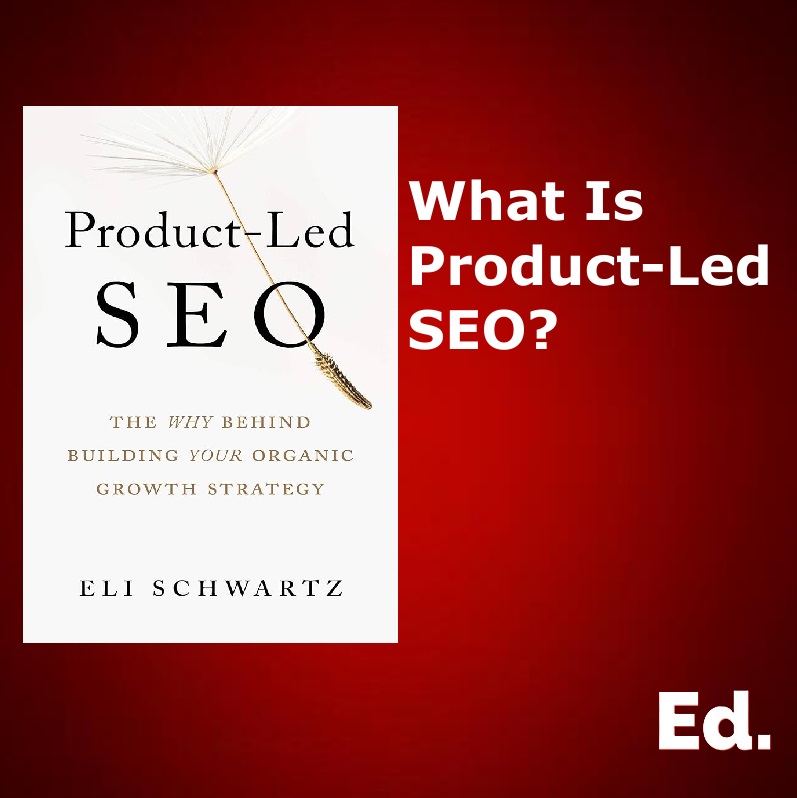
Product-Led SEO is a concept introduced by Eli Schwartz in his book, Product-Led SEO: The Why Behind Building Your Organic Growth Strategy.
The book offers a strategic guide that challenges the traditional, keyword-obsessed approach to Search Engine Optimization.
Instead of chasing algorithms or high-volume keywords, Schwartz argues for a “product-led” approach.
He suggests building a high-quality product that inherently solves user problems, thereby generating its own search demand and organic growth.
Here is a detailed summary of the book, organized by its core philosophy, key concepts, and a chapter-by-chapter breakdown.
What is Product-Led SEO?
The central thesis of the book relies on the economic concept of “Red Ocean” vs. “Blue Ocean” strategies.
Traditional SEO (Red Ocean) is a “bloody” war of attrition where competitors fight over the same finite set of high-volume keywords.
It is a zero-sum game where you write content solely to rank, often resulting in commoditized, low-value pages.
Product-Led SEO, on the other hand, is a Blue Ocean that creates new demand or captures untapped demand.
By building a product that users naturally search for (e.g., specific data, programmatic pages, unique tools), you create a “Blue Ocean” where you have no direct competition.
You aren’t fighting for a keyword; you are the answer to a specific user intent.
The Golden Rule:
Build for the user first, and the search engine second. If a page doesn’t have a reason to exist for a human user, it shouldn’t exist for a bot.

One of the key concepts of the book is the difference between Product-Led SEO and Marketing-Led SEO.
Where marketing Led SEO might lead to a statement like…
“I need to rank for ‘best credit card’, so I will write a 2,000 word blog post”,
An SEO with Product LEd mindset might say…
“I have a database of every credit card’s fees and interest rates. I will build a comparison engine that generates a unique page for every card and every comparison combination (e.g., ‘Visa vs. Amex’).”
The former is a manual, unscalable and highly competitive process, while the latter is scalable, programmatic and high-utility
Schwartz adapts the product management RICE framework to help SEOs prioritize tasks that actually move the needle, rather than just “fixing errors.”
- R (Reach): How many pages or users will this change affect?
- I (Impact): Will this significantly increase revenue/traffic, or just marginally?
- C (Confidence): How sure are we that this will work? (Do we have data?)
- E (Effort): How many engineering hours will this take?
A major pillar of Product-Led SEO is using data to generate thousands of high-value pages automatically.
- Examples: Zillow (a page for every address), TripAdvisor (a page for every hotel/city combo), LinkedIn (a public profile for every user).
- Why it works: It targets “long-tail” queries (highly specific searches) which have lower volume individually but massive aggregate volume and higher conversion intent.
Phase I: The Strategic Foundation
Introduction & Chapter 1: Why Traditional SEO is a Red Ocean
Schwartz opens by explaining that “best practices” are often myths.
Following the same checklist as your competitors (H1 tags, keyword density) only guarantees mediocrity.
He introduces the concept that SEO should be a strategic function, not just a tactical marketing task.
Chapter 2: Defining Product-Led SEO
This chapter defines the methodology needed for a successful implementation of Product-Led SEO.
The product itself being the driver of search traffic, success demands deep collaboration between SEOs, product managers, and engineers.
The goal is to build “SEO features” (like reviews, directories, or calculators) rather than just “SEO content” (blog posts).
Chapter 3: Audience and Intent First
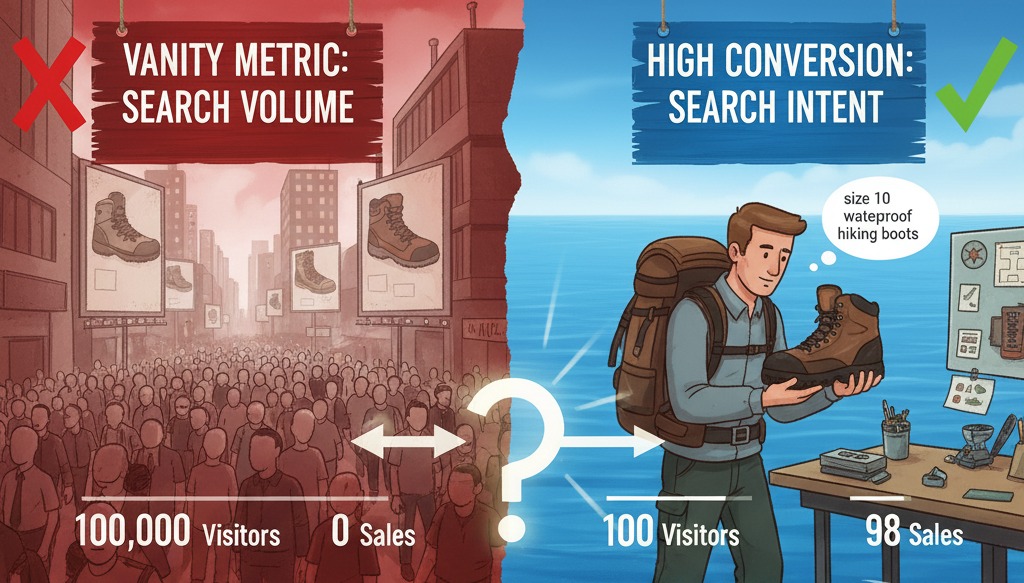
Schwartz argues that Search Volume is a vanity metric. You should focus on Search Intent instead.
- Example: Ranking #1 for “shoes” (high volume) might bring 100,000 visitors but 0 sales if they are looking for pictures of shoes. Ranking #1 for “size 10 waterproof hiking boots” (low volume) will drive high conversion.
- He urges readers to ignore keyword tools initially and instead talk to customers to understand their actual problems.
Phase II: Execution and Integration
Chapter 4: Building SEO into Product Development
SEO cannot be an afterthought applied after the code is shipped. It must be baked into the product roadmap.
This chapter details how to “sell” SEO to engineers and product leaders by speaking their language (growth, user acquisition, scalability) rather than SEO jargon (canonical tags, crawl budget).
Chapter 5: Scaling SEO Without Traditional Tactics
This chapter dives into Programmatic SEO. Schwartz explains how to leverage internal proprietary data or public datasets to create massive scale.
Key point: You don’t need to write the content; your users or your data should write it for you. (e.g., User-Generated Content like reviews or Q&A sections).
Chapter 6: Measuring SEO Success
Stop reporting on rankings. Rankings are volatile and personalized.
- The Better Metric: Organic Traffic and Revenue.
- The North Star: “Incremental Lift.” If you turn off SEO efforts, what happens? Measure the business impact of search, not just the position on Google.
Phase III: Advanced Strategy
Chapter 7: Building Authority & Content
While programmatic is key, brand authority still matters. This chapter covers how to create “Strategic Content” that earns backlinks naturally because it is useful/novel, rather than begging for links.
Chapter 8: The Company and SEO (Organizational Buy-In)
How to structure an SEO team. Schwartz advises against burying SEO under “Marketing.”
It often belongs closer to “Product” or “Engineering” in a product-led organization.
He also discusses how to hire SEOs who are strategic thinkers, not just checklist-followers.
Chapter 9: Global Expansion (International SEO)
Just translating keywords doesn’t work because search behavior differs by culture.
- Example: A “sale” in the US might be a “promotion” in the UK.
- You must understand the local intent and competition (Blue Ocean) in each new market.
Is Product-led SEO The Future of Search?
Schwartz concludes that algorithms change daily, but user behavior changes slowly. If you focus on the user, you are “algorithm-proof.”
Actionable Takeaways for You
If you want to apply Product-Led SEO to your business today:
- Stop “Keyword Research”: Start with “Customer Research.” Ask your sales/support teams what questions customers actually ask, and build pages that answer those specific questions.
- Audit Your “Zombie” Pages: Look for pages on your site that have no traffic and no clear user utility. Delete or merge them. Quality > Quantity.
- Identify Your Data Assets: Do you have proprietary data? (e.g., pricing trends, user reviews, location data). Can you turn this into thousands of unique, helpful landing pages?
- Use the RICE Score: Next time you want to request an SEO fix from your dev team, calculate its Reach, Impact, Confidence, and Effort to justify the request.
Discover more from Deconstruct Ed.
Subscribe to get the latest posts sent to your email.

