
Categories
News SEO

Google’s March And June 2025 Core Updates

The first half of 2025 has been pretty bumpy, with some major ups and downs in rankings after the March 2025 Core Update and its follow-up in June 2025.

So, what’s the deal with these new updates?

Google’s really ramping up its game to get rid of all that “unhelpful” and junky content, and it’s shaking things up in search results, causing quite a buzz in the SEO world!

The March 2025 Core Update

The March update hit the scene with a bang, and right off the bat, people were noticing one big thing…

Google is getting way better at spotting and pushing down content that doesn’t really do much for users.

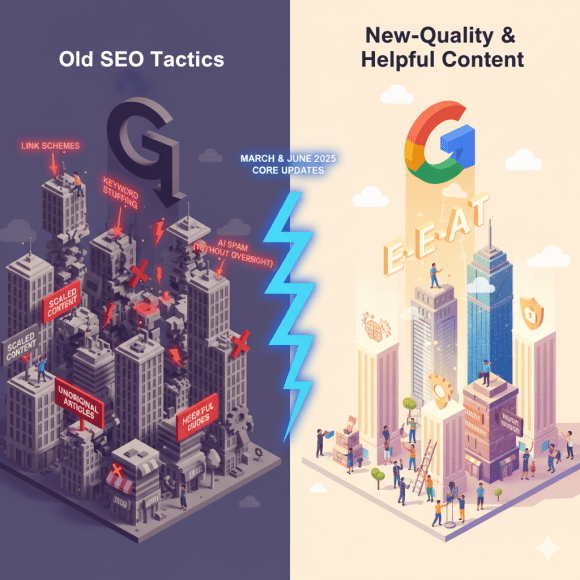
The algorithm targeted websites that used to score big with black hat strategies like:​

  • Churning out tons of articles on the same stuff, usually just rehashing what’s already out there.
  • ​Copying, spinning, or aggregating content without adding unique insights, research, or a fresh perspective.
  • ​Filling articles with grammatical errors, poor structure, lack of depth, or misleading information.​

…they all began to see their rankings plummet, so fast, you would have thought they were hit by giant missile!

It was a real eye-opener for a lot of businesses, driving home the point that just cranking out more trashy content will only do more harm than good.
The June 2025 Core Update

The March update got things rolling, but the June 2025 Core Update really took it up a notch.

The update basically fine-tuned and improved on what was already set in March.

It showed that Google was serious about prioritizing content that’s actually helpful, high-quality, and original.

It was as if Google was saying, “We’re not joking—we’re going to make the search results better!”

The impact was immediate and, for some, devastating.

Websites that managed to weather the March update, perhaps due to a slower rollout of the algorithm or less direct targeting, found themselves caught in the June wave and saw further declines.

So Who Was Most Impacted?​

The sites that got hit hard by these updates usually had some things in common:​

  1. They either ran content farms out of junk content and let robots do the writing. Or they would just copy and paste stuff from other websites without adding anything worthwhile.
  2. They were affiliate sites, especially those thrown together just to game the SEO system. They often lacked any real unique reviews or insights.
  3. They were sites with keyword-Stuffed, unnatural Content. The latest updates heavily cracked down on those kind of domains that crammed content with keywords in the hopes of gaming the system.
  4. Sites that attempted to artificially inflate rankings through link schemes, cloaking, or other deceptive practices.​

Look..the bottom line is, although AI content is getting better, any text that’s 100% cranked out by machines and not touched by human hands will be ignored. Or worse, penalized!

Google’s algorithms are becoming increasingly sharper and can sniff out unoriginal materials, no matter if it was made by a person or a robot.

So if you’re trying to bounce back or even shine in this new online world, Google’s got one straightforward tip:

Deliver what your users really want.

Sounds like it’s time to really lean into E-E-A-T (Experience, Expertise, Authoritativeness, and Trustworthiness) because nailing these points is more important now than ever.

Here are some key recommendations for adapting:

Focus on putting out content that brings fresh ideas, thorough research, cool viewpoints, or actual experiences to the table.

Whilst doing so, think about being helpful and ask yourself if your content really answers someone’s question the right way, or gives a unique perk.

It’s important to make sure your content is written by people who actually know what they are talking about and have some real experience.

You can even mention the authors and share their credentials, in a nice lil byline!

Whatever you, just be real, share the facts, and back up what you say.

Go for white-hat SEO methods – think about building links the right way, keeping your website technically solid, and churning out great content instead of trying to cheat the system.

The March and June 2025 Core Updates are a big deal in Google’s journey to build a more helpful and trustworthy internet.

This shake-up is a solid reminder that it’s really about giving users the best information and experience possible.

If you take this idea to heart, you’ll definitely be the one of the few who comes out on top in the future.

Categories
News SEO

Google Updates Content Blocking for AI Overviews

Google just dropped an update in their docs on how content creators can keep their content from showing up in AI overviews.

This move comes at a time when content creators are continuously finding new ways to navigate the evolving space of AI-powered search results and control its impact on website traffic.

The updated guidance basically breaks down the troubleshooting steps for those that have implemented anti-AI preview controls but are still seeing their content show up in AI the overview section.

It’s a move that shows Google is stepping up their game to help creators handle the nuances of AI integration in search.

The search giant is making it easier for everyone to understand what they need to do to control how their content appears on their tool.

Key takeaways from the updated documentation include:

  • Preview Controls Verification: Google really wants you to make sure that your preview controls (like meta name="robots" content="nosnippet" or data-nosnippet) are set up right and that Googlebot can see them. So make good use of the URL Inspection tool in Google Search Console; it’s super helpful for confirming everything’s working as it should!
  • Recrawling Reminder: Just a heads up, if you change things in your preview controls, it might take a while to see those updates — anywhere from a few days to a couple of months, depending on when Google decides to recrawl. The good news is, if you ask for a recrawl in Search Console, it might speed things up a bit!
  • Community Support: If you’re running into some tough issues with your website, Google suggests checking out the Google Search Central Help Community. It’s a great place to team up with other webmasters, content writers, publishers etc. and figure things out together!

This update highlights the constant interaction happening between Google and webmasters about using web content for those AI-generated summaries.

How to Turn Off Google AI for Searches?

As you might already know, it’s impossible to completely get rid of Google’s AI Overviews.

But you can definitely make them appear less often or switch back to the old-school search view, where you only see links.

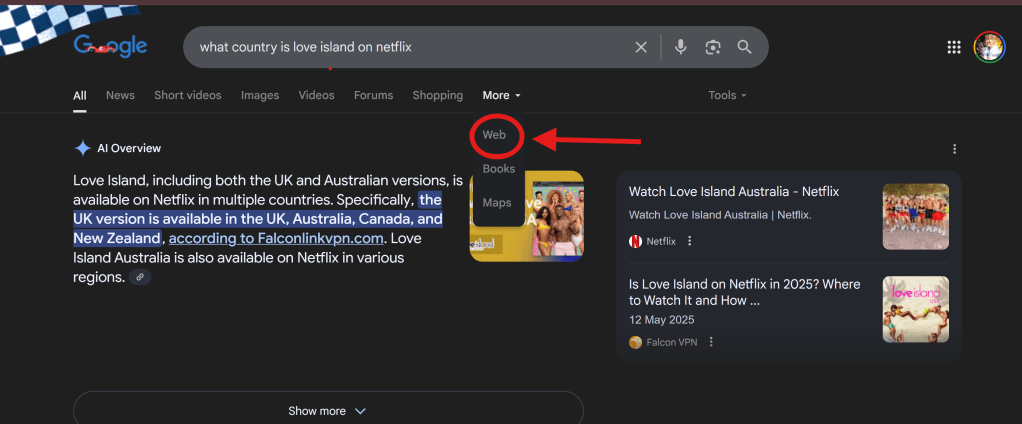
The easiest way to get around AI overviews is by hitting the “Web” tab in Google Search results—this lets you see regular links without the AI BS.

Here’s how:

  • When you do a Google search, the results page shows a bunch of tabs like “All,” “Images,” “News,” and more.
  • Locate the “Web” tab (you may need to scroll horizontally to find it).
  • Clicking the “Web” tab will display the traditional search results, effectively bypassing the AI Overview. 
Screenshot of a Google search results page with an AI Overview section highlighting availability of 'Love Island' on Netflix and a 'Web' tab highlighted.
Screenshot of Google search results showing the option to switch to the ‘Web’ tab, bypassing AI Overviews for a traditional search experience.

If you want, you can also switch up your browser to something like Firefox or Safari, since they don’t show AI Overviews (yet).

If you get really creative with your search terms or make them super specific, it might help you steer clear of those AI overviews.

There are tons of browser extensions out there that can help you block or hide those AI Overviews. Some of the best ones to choose include:

  • “Hide Google AI Overviews”
  • “Disable AI Overview”
  • “Bye Bye, Google AI”

Whichever one you choose, just make sure you do your homework and only pick ones from trusted sources to steer clear of any security headaches.

How To Block Google From Using Your Content To Train AI

Google says its AI Overviews and AI Mode are meant to deliver quick, helpful answers and point people to various relevant sources, but it seems like that sentiment isn’t shared by everyone.

Some creators are really stressing about all the fake info spewed by AI overviews, and don’t want their pages referenced on them, because it could damage their credibility.

For this reason, many add “NoAI” tags to the header of their pages or in the meta data, telling Google not to use their work to train AI models.

Just a heads up…if you block Google-Extended (that’s a crawler for some of Google’s AI products like Gemini), it’ll keep those bots from using your content to train their AI, but it won’t affect how your site shows up in regular Google Search or AI Overviews.

So if you really want to keep your content out of AI Overviews, you’ve got to block Googlebot from crawling those pages.

But!

That would also make your pages disappear from regular search results…

As you can see: finding that sweet spot between being seen and having complete control over your content can be tricky.

That’s why it’s super important for creators to find tools that can help them make smarter decisions about their web presence, as Google keeps updating its docs and changing the way search is done.

I’d advise you subscribe to my newsletter to keep up with the latest best practices for handling content in this ever-changing search world.

That way, you will be the first to know about any new information regarding Google, as they will be sent directly to your inbox regularly.