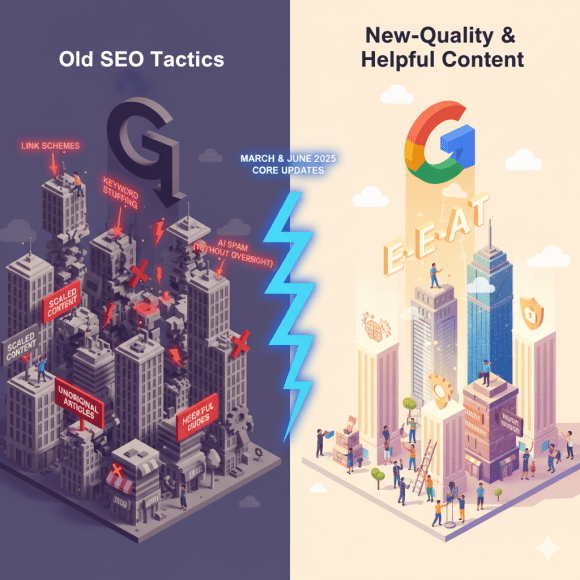
The first half of 2025 has been pretty bumpy, with some major ups and downs in rankings after the March 2025 Core Update and its follow-up in June 2025.
So, what’s the deal with these new updates?
Google’s really ramping up its game to get rid of all that “unhelpful” and junky content, and it’s shaking things up in search results, causing quite a buzz in the SEO world!
The March 2025 Core Update
The March update hit the scene with a bang, and right off the bat, people were noticing one big thing…
Google is getting way better at spotting and pushing down content that doesn’t really do much for users.
The algorithm targeted websites that used to score big with black hat strategies like:
Churning out tons of articles on the same stuff, usually just rehashing what’s already out there.
Copying, spinning, or aggregating content without adding unique insights, research, or a fresh perspective.
Filling articles with grammatical errors, poor structure, lack of depth, or misleading information.
…they all began to see their rankings plummet, so fast, you would have thought they were hit by giant missile!
It was a real eye-opener for a lot of businesses, driving home the point that just cranking out more trashy content will only do more harm than good.
The June 2025 Core Update
The March update got things rolling, but the June 2025 Core Update really took it up a notch.
The update basically fine-tuned and improved on what was already set in March.
It showed that Google was serious about prioritizing content that’s actually helpful, high-quality, and original.
It was as if Google was saying, “We’re not joking—we’re going to make the search results better!”
The impact was immediate and, for some, devastating.
Websites that managed to weather the March update, perhaps due to a slower rollout of the algorithm or less direct targeting, found themselves caught in the June wave and saw further declines.
So Who Was Most Impacted?
The sites that got hit hard by these updates usually had some things in common:
They either ran content farms out of junk content and let robots do the writing. Or they would just copy and paste stuff from other websites without adding anything worthwhile.
They were affiliate sites, especially those thrown together just to game the SEO system. They often lacked any real unique reviews or insights.
They were sites with keyword-Stuffed, unnatural Content. The latest updates heavily cracked down on those kind of domains that crammed content with keywords in the hopes of gaming the system.
Sites that attempted to artificially inflate rankings through link schemes, cloaking, or other deceptive practices.
Look..the bottom line is, although AI content is getting better, any text that’s 100% cranked out by machines and not touched by human hands will be ignored. Or worse, penalized!
Google’s algorithms are becoming increasingly sharper and can sniff out unoriginal materials, no matter if it was made by a person or a robot.
So if you’re trying to bounce back or even shine in this new online world, Google’s got one straightforward tip:
Deliver what your users really want.
Sounds like it’s time to really lean into E-E-A-T (Experience, Expertise, Authoritativeness, and Trustworthiness) because nailing these points is more important now than ever.
Here are some key recommendations for adapting:
Focus on putting out content that brings fresh ideas, thorough research, cool viewpoints, or actual experiences to the table.
Whilst doing so, think about being helpful and ask yourself if your content really answers someone’s question the right way, or gives a unique perk.
It’s important to make sure your content is written by people who actually know what they are talking about and have some real experience.
You can even mention the authors and share their credentials, in a nice lil byline!
Whatever you, just be real, share the facts, and back up what you say.
Go for white-hat SEO methods – think about building links the right way, keeping your website technically solid, and churning out great content instead of trying to cheat the system.
The March and June 2025 Core Updates are a big deal in Google’s journey to build a more helpful and trustworthy internet.
This shake-up is a solid reminder that it’s really about giving users the best information and experience possible.
If you take this idea to heart, you’ll definitely be the one of the few who comes out on top in the future.
Gone are those days when you had to cram a bunch of keywords into your content, or build a farm of links to have a successful SEO campaign.
A successful SEO campaign isn’t just about tweaking keywords or building links…
it’s more like a smart business move that kicks off with a detailed, multi-layered discovery process.
In this article, I’ve laid out seven key questions—or “types” of questions—that you need to tackle before diving into any SEO project.
By pulling together insights from business goals, website health, competition, and how users think, this framework gives you a roadmap for turning your site into a strong, money-making, and respected organic traffic source.
In this article, I’ll help you to really understand how to sync up your SEO work with your main business goals, set achievable expectations, and create a strategy that can handle the ever-changing world of search engines and market rivals.
The seven types of questions are:
What Are The Business & Money Goals?
Who’s Interested & What Are They Looking For?
What’s The Competition Up To?
What Is The Website’s Past & How Is It Doing Tech-wise?
How Much Content Do You Have?
What Are The Operational & Resource Limits?
What Are The Success Metrics & Reporting Expectations?
These questions make up a go-to guide for anyone looking to get solid information, whether they’re a marketing manager, agency owner, or just a content creator flying solo.
1. What Are The Business & Money Goals?
This type of question lays down the basic “why” of the SEO campaign, making sure that all the decisions you make later on are in sync with the main business goals.
Instead of just chasing after empty stats, you really need to dig deeper into the reason for which you are doing SEO.
Rather than just wanting “more traffic”, you need to get to the heart of what “profit” and return on investment (ROI) means to the business.
Every SEO campaign, no matter how big or small, should kick off with clear, measurable goals. Saying “get more sales” is just an appetizer, not the main course.
You’ve got to narrow it down to the kind and quality of leads or sales we really want.
And that means knowing the client’s current processes inside and out and spotting areas that could use some work.
For example, if a client is pulling in tons of leads but they’re not really that great, the aim of the campaign could be to fine-tune the online audience so you’re only getting the most relevant demographics.
In that case, you might need to kick things off with questions that dig into the client’s financial model.
To get a solid grip on how the business makes money, you could ask:
“Which products or services are your cash cows?”
This insight will help you figure out where to put your SEO efforts.
But here’s the kicker: The strategy varies a lot from one industry to another.
For an e-commerce shop, you might want to highlight products that rake in the most cash or those that are trending right now.
But in the medical space, boosting local patient visits or pushing certain high-value services could be the goal.
Alternatively, for construction companies, ranking for specific project types in local searches could be what’s needed.
This tailored approach to each industry ensures your SEO work is actually driving revenue, and isn’t just to get customers.
You would be snagging profitable customers from organic traffic.
But reaching this goal means you have to understand metrics that go beyond just counting how many people visit the site.
Most SEO guys often kick things off by first looking at traffic and rankings, but those are merely fancy stats that mean little without financial value.
The real connection between those figures and the big win of “more sales” lies in financial metrics like Customer Lifetime Value (CLV), Cost Per Acquisition (CPA), and Return on Investment (ROI).
These numbers link the campaign straight to financial success.
The following table lays out a number of SEO success metrics that are tied to financial value, to help you guide the way.
Table: SEO Success Metrics Hierarchy
Tier
Metric Examples
Description & Strategic Value
I (Business)
ROI, CLV, CPA, Profit Margin, Revenue Growth
These are the ultimate business metrics that prove the SEO campaign’s financial viability. They link organic efforts directly to the bottom line, proving long-term value.
II (Conversion & Engagement)
Organic Conversions, Conversion Rate, New Leads, CTR, User Engagement
These metrics measure how effectively organic traffic is turning into business outcomes. They bridge the gap between technical performance and financial results.
These are the foundational metrics that indicate the campaign is gaining traction. While important, they are leading indicators that do not fully capture business success on their own.
2. Who’s Interested & What Are They Looking For?
Make sure your campaign is rooted in real human psychology, not just a bunch of mechanical algorithms.
In other words, get inside the head of the person typing away at their search bar and figure out what they really want.
One of the biggest mistakes marketers make is thinking their audience is “everyone”.
A smarter way to go would be to nail down the target audience by looking at demographics, but even more crucially, psychographics.
This way, you really get what drives them, what their fears are and what bothers them.
This kind of detail is invaluable for creating content that truly resonates with people and meets their needs.
To dig up this information, you need to ask some pointed questions about age, gender, and income.
Even more important than all that, you’ve got to dig deeper into what makes them tick.
Think in terms of…
What pushes someone to make a purchase?
What are their main fears or worries—both at work and in their personal lives?
How do they usually research products or services before they buy, and who do they turn to for advice?
By peeling back these layers, you can build detailed profiles that act as the backbone of the whole campaign.
A campaign’s knack for building E-E-A-T (Experience, Expertise, Authoritativeness, Trustworthiness) really hinges on how well it gets what the audience is thinking and feeling deep down.
Think of a search query as a peek into someone’s real issue or need which are tied back to what they are worried about or what’s bothering them.
For instance, when someone types “how to fix a leaky faucet,” it’s usually because they’re stressed about possible water damage or dreading a big plumbing bill.
If your content just skims the surface with basic solutions, it’s not going to rank well compared to a detailed guide that…
digs into the user’s real worries,
highlights the author’s knowledge,
and builds trust through clear and organized information
So, diving deep into what makes your audience tick is more than a nice-to-have; it’s essential for crafting content that actually helps out.
This, in turn, can boost your rankings, get people more engaged, and maintain your authority.
The goal here is to turn these psychological insights into actionable keyword research.
Moreover, by really understanding what your audience is concerned with, you can pinpoint the four big types of user intent:
Informational, Navigational, Transactional, and Commercial Investigation.
For example, if someone’s worried about getting shoddy work done, they might search for “guide to choosing a home renovator,”…
whereas someone looking for a deal might type “best deals on outdoor gear.”
Keep in mind that most topics have a mix of intentions, and the search results pages (SERPs) show what Google thinks people are after.
The table below lines up audience psychographics with the keywords and content formats that will really hit the spot.
Table: Audience Persona & Search Intent Map
Persona Trait
Underlying Need/Fear
Search Queries/Keywords
User Intent
Content Format
The Frugal Homeowner
Fear of overspending on repairs
“DIY leaky faucet,” “best caulk for bathroom,” “cheap home repair guide.”
Informational, Commercial Investigation
How-to guides, comparison articles, listicles of budget-friendly products
Product reviews, pricing pages, detailed course descriptions, case studies
The Tech-Savvy Millennial
Desire for a new gadget
“Samsung Galaxy Z Fold 5 reviews,” “buy Galaxy Z Fold 5,” “where to buy cheap Z Fold 5.”
Informational, Transactional
Video reviews, product landing pages, pricing grids, store locators
3. What’s The Competition Up To?
As any avid gamer would say “get to know the battlefield first before attacking the opps!”.
In business terms..this means, to do a deep dive and spot chances for standing out, that highlight where your competitors might be weak.
A solid SEO plan needs to not only know who the competitors are but also…
what they’re doing right,
where they’re dropping the ball,
and what makes your business special
It’s important to realize that competitors can vary between business models and SEO approaches.
For example, one might be a big industry blog rocking those informational keywords, while another is a smaller competitor going after those transactional terms.
When you dive into a competitive analysis, first fish out who the main players are.
Ask yourself the following questions:
Who are the top competitors, both online and offline?
What’s their game in marketing, and what do customers love or hate about them?
And, of course, what’s your Unique Selling Point (USP) that sets you apart from the rest?
This last bit is super important because it shapes the core message for your entire campaign.
Don’t make the mistake of copying what others do!
Instead find that “untapped market space” where you can really shine.
A lot of marketers make the erroneous move of checking what competitors are ranking for and trying to beat them at their own game.
Most marketers do this because it feels safe, but this often turns into an expensive, head-to-head struggle for those high-traffic, super-competitive keywords.
A smarter play is to spot the “gaps or weaknesses” in what competitors are doing.
Maybe a competitor has a solid backlink profile but their content is pretty weak.
In that case, the savvy move would be to take advantage of that by crafting “better content” using tricks like the “Skyscraper Method”.
This way, you can build authority in a niche that the competitor has overlooked, making you the go-to expert on the topic.
While you’re positioning yourself as the go to expert, keep an eye on what your rival’s customers are saying…
For instance, if feedback shows that people stopped buying from a competitor because of lousy customer service, your content can shine a light on your top-notch service and quick responses.
This way, your brand comes across as a trustworthy choice and directly tackles a pain point the competition is ignoring.
Carve out a solid position, don’t just scramble for a short-term ranking.
The following table lays out a multi-faceted approach to competitive analysis.
Table: Multi-Faceted Competitor Analysis
Dimension
Client
Rival A (Direct)
Rival B (Content)
Weakness
Strategic Action
USP
Customer-first service
Low price leader
Niche industry expert
Rival A’s low quality customer service
Create content on “What to Look for in a Provider”
Core Keywords
[List of terms]
[List of terms]
[List of terms]
Keyword gaps in Rival A & B’s content
Target underserved long-tail keywords
Content Authority
Moderate
High volume, low quality
High quality, consistent
Rival A’s thin content
Update older content with expert insights
Backlink Profile
Moderate
Strong, but many from low-quality sites
Strong from industry sites
Rival A’s reliance on toxic links
Focus on earning high-quality, relevant links
Consumer Sentiment
Positive
Negative reviews about service
High praise for expertise.
Rival A’s pain points
Build trust by addressing consumer concerns
4. What Is Your Website’s Past & How Is It Doing Tech-wise?
Before diving into a new strategy, you’ve gotta get a grip on the foundations.
A “pre-flight check” helps you spot potential penalties, any historical baggage, and technical hiccups that could sink a campaign before it kicks off.
If your website has a bad domain history or existing technical problems, that can really hold things back.
And by bad domain history, I’m not referring to 404 errors…
I mean having a reputation problem that often needs rebuilding trust with both search engines and users.
At this point, start by checking if your site has ever been hit with penalties or warnings from Google.
Dig deep into the domain’s history because a domain that’s been involved in spam, malware, or scams can cause some serious headaches – like indexing problems for new pages and lower search rankings.
In this case, any proactive SEO work, like creating content, researching keywords, or building links, will be held back by that sketchy domain history.
The initial phase of the campaign is about cleaning things up and building trust.
To create a strategy based on a solid historical audit, you have to disavow links, submit new sitemaps, and check the current technical state of the website.
Ask yourself: Are there any issues like broken links or slow load times?
See the checklist below for a handy framework for this foundational audit.
Question
Answer/Finding
Strategic Effect
Have there been previous SEO efforts?
Yes, we hired an agency two years ago
Review past audits and results to identify past mistakes and gaps
Has the website received a penalty?
Not to our knowledge, but traffic dropped suddenly last year
Conduct a manual penalty check and backlink audit to confirm
What is the domain history?
It was a clean domain
Proceed with a standard SEO campaign without the need for initial remediation
What CMS is in use?
WordPress with a custom theme
The strategy can incorporate a wide range of plugins and on-page optimizations
Is an in-house developer available?
Yes, on a weekly basis
Technical fixes can be prioritized and implemented promptly
5. How Much Content Do You Have?
Take a good look at your current content stash, figuring out what’s actually there and what’s worth keeping based on the new campaign goals.
Your best treasure is usually your existing content and an audit helps pinpoint what can be used again…
Maybe there’s an awesome article that needs a little sprucing up?
What can and should be tossed out?
Think of the thin, low-quality content.
Many clients jump to the conclusion that they just need to “pump out more blog posts,” but that’s a one-way street that eats up resources.
A smarter play is to check out what they already have first.
Ask yourself these key questions, for a thorough content audit:
Is there a current content strategy, and how often do they churn out new stuff?
Who’s in charge of keeping things updated?
Plus, what’s actually working well, and how do we define “working well”?
The main goal is to find content that’s already killing it in rankings so it can be improved even more. These can be tweaked or repurposed to other formats such as infographics, images, podcasts etc.
That way, you build up the site’s authority using what already works instead of cranking out endless new materials.
This sets off a cycle where better content gets even more traffic and links, which ups the site’s authority.
And with higher authority, future content stands a better chance of ranking well too, making life easier with each new piece.
This approach shifts things from a “cost-per-blog” model to managing assets strategically.
You can use the following matrix to sort out existing content and guide your strategy.
Table: Content Audit & Strategy Matrix
Quadrant
Description
Strategic Action
Keep & Optimize
High-performing content with outdated information or a low conversion rate
Update the information, add new media (e.g., video), and improve the call to action (CTA)
Keep & Promote
High-quality content that is not ranking well and has few backlinks
Build internal and external links to the page, and promote it on social media
Consolidate & Redirect
Multiple pieces of thin, similar content targeting the same keywords
Combine the best elements into a single, comprehensive page and set up 301 redirects from the old URLs
Remove & Disavow
Low-quality, thin, or spammy content that is damaging the site’s authority
Delete the content and use a 410 (Gone) status code to signal to search engines that it will not return
6. What Are The Operational & Resource Limits?
Take the strategy from just being a cool idea to something that actually works by checking out what the client has in terms of resources, team setup, and budget.
There’s no point in having the best SEO strategy if the client can’t afford it or doesn’t have the right setup to pull it off.
By understanding these limits from the start, you avoid any awkward moments or crazy expectations later on.
Here are some questions you can fire off from the start, to make sure the strategy works:
What’s the budget for this project?
Is it a one-time thing or will there be ongoing costs?
Who’s the go-to person for SEO chats, and who calls the shots?
What’s their operational reality? For instance, how long does it usually take to get content approved and posted?
How much help will the in-house dev or marketing team offer, and how savvy are they with SEO stuff?
A solid SEO plan has to grasp both the human side of things and the operational setup, in addition to the search engine algorithms.
A technically “perfect” SEO audit might suggest a full site migration, but that advice goes out the window if the client’s on a tight budget and doesn’t have developers on standby.
In that case, you might need to conjure up a new plan that doesn’t drain resources.
So instead of going for a big migration, the strategy could zoom in on on-page content tweaks or link building, as those can be tackled with fewer hands on deck.
Keep in mind that the best strategy isn’t always the one that looks good on paper, but the one that can actually work in real life.
In that sense, any SEO engineer needs to be like a translator, turning techy recommendations into a game plan that fits what the client can realistically do.
The following table lays out how to match up strategic moves with what clients can manage.
Table: Operational & Resource Alignment
Strategic Action
Required Client Resources
Potential Roadblock
Technical Fixes
Access to CMS, in-house developer, project manager
Developer’s time is limited or developer lacks SEO knowledge
Content Production
Content writer, subject matter expert, budget for freelancers
Content approval process is slow, or team lacks a dedicated writer
Link Building
Budget for digital PR, willingness to create linkable assets
Legal team must approve all outbound communication
7. What Are The Success Metrics & Reporting Expectations?
How you measure, report, and, most importantly, adapt the campaign’s success over time matters a great deal.
Set some real expectations early on and turn the SEO relationship into a long-term, flexible partnership.
Remember: If you can’t measure it, you can’t manage it!
Before you dive in, you need to nail down the success metrics and timeline.
So, ask some key questions like:
What metrics will show us we’re doing well (like organic traffic, rankings, conversions)?
What tools will we use to keep track (think Google Analytics, Google Search Console, and other SEO tools)?
What does the client expect regarding timing and results?
You should also explain the two types of SEO metrics:
Leading indicators, like keyword rankings and search visibility,
Lagging indicators such as conversions and ROI.
Above all, the main question you should be asking, isn’t really “When will I see results?” but more like “How do I adapt when things change?”
Once you adopt that mindset, suddenly the focus shifts from “Am I on track?” to “What’s changed, and how do I adjust?”
Businesses and junior marketers often think of SEO as a quick fix with a by-the-date result.
But SEO is really a dynamic, long-term game that gets influenced by things we can’t control, like algorithm changes and what competitors are up to.
And it’s up to you as a strategist to help reset these expectations.
You can use the following template for a complete reporting dashboard.
Table: SEO Reporting Dashboard Template
Metric
Source
Significance
Organic Traffic
Google Analytics
A high volume indicates content is discoverable and appealing
Organic Conversions
Google Analytics
Measures how well organic traffic is converting into leads or sales
Keyword Rankings
Third-party SEO Tool
Indicates changes in a page’s visibility for a specific term
CTR
Google Search Console
A high CTR suggests the title and meta description are compelling
Bounce Rate
Google Analytics
A high bounce rate may indicate that content isn’t meeting user intent
A solid SEO campaign means planning smart and diving deep into analysis.
Use the seven-types framework in this article as a roadmap to turn your website from just a basic online hangout into a strong, money-making, trusted source that drives organic traffic.
This method makes sure that every SEO move you make is in sync with what your business really wants.
It is backed by a clear understanding of who your audience is, and taking a hard look at the competition and your own setup.
One healthy tip I can give you is to make sure that you start with this thorough discovery process because..
skipping these crucial questions usually leads to chasing empty metrics, ignoring real-life issues, and ultimately not getting a good ROI.
The real magic of a skilled SEO strategist isn’t just their knack for handling technical tasks, but their ability to:
Ask the right questions right from the start
Turn complex data into a straightforward business game plan
Keep a flexible, long-term relationship focused on growth