

Categories
News SEO

Google’s March And June 2025 Core Updates

The first half of 2025 has been pretty bumpy, with some major ups and downs in rankings after the March 2025 Core Update and its follow-up in June 2025.

So, what’s the deal with these new updates?

Google’s really ramping up its game to get rid of all that “unhelpful” and junky content, and it’s shaking things up in search results, causing quite a buzz in the SEO world!

The March 2025 Core Update

The March update hit the scene with a bang, and right off the bat, people were noticing one big thing…

Google is getting way better at spotting and pushing down content that doesn’t really do much for users.

The algorithm targeted websites that used to score big with black hat strategies like:​

  • Churning out tons of articles on the same stuff, usually just rehashing what’s already out there.
  • ​Copying, spinning, or aggregating content without adding unique insights, research, or a fresh perspective.
  • ​Filling articles with grammatical errors, poor structure, lack of depth, or misleading information.​

…they all began to see their rankings plummet, so fast, you would have thought they were hit by giant missile!

It was a real eye-opener for a lot of businesses, driving home the point that just cranking out more trashy content will only do more harm than good.

The June 2025 Core Update

The March update got things rolling, but the June 2025 Core Update really took it up a notch.

The update basically fine-tuned and improved on what was already set in March.

It showed that Google was serious about prioritizing content that’s actually helpful, high-quality, and original.

It was as if Google was saying, “We’re not joking—we’re going to make the search results better!”

The impact was immediate and, for some, devastating.

Websites that managed to weather the March update, perhaps due to a slower rollout of the algorithm or less direct targeting, found themselves caught in the June wave and saw further declines.

So Who Was Most Impacted?​

The sites that got hit hard by these updates usually had some things in common:​

  1. They either ran content farms out of junk content and let robots do the writing. Or they would just copy and paste stuff from other websites without adding anything worthwhile.
  2. They were affiliate sites, especially those thrown together just to game the SEO system. They often lacked any real unique reviews or insights.
  3. They were sites with keyword-Stuffed, unnatural Content. The latest updates heavily cracked down on those kind of domains that crammed content with keywords in the hopes of gaming the system.
  4. Sites that attempted to artificially inflate rankings through link schemes, cloaking, or other deceptive practices.​

Look..the bottom line is, although AI content is getting better, any text that’s 100% cranked out by machines and not touched by human hands will be ignored. Or worse, penalized!

Google’s algorithms are becoming increasingly sharper and can sniff out unoriginal materials, no matter if it was made by a person or a robot.

So if you’re trying to bounce back or even shine in this new online world, Google’s got one straightforward tip:

Deliver what your users really want.

Sounds like it’s time to really lean into E-E-A-T (Experience, Expertise, Authoritativeness, and Trustworthiness) because nailing these points is more important now than ever.

Here are some key recommendations for adapting:

Focus on putting out content that brings fresh ideas, thorough research, cool viewpoints, or actual experiences to the table.

Whilst doing so, think about being helpful and ask yourself if your content really answers someone’s question the right way, or gives a unique perk.

It’s important to make sure your content is written by people who actually know what they are talking about and have some real experience.

You can even mention the authors and share their credentials, in a nice lil byline!

Whatever you, just be real, share the facts, and back up what you say.

Go for white-hat SEO methods – think about building links the right way, keeping your website technically solid, and churning out great content instead of trying to cheat the system.

The March and June 2025 Core Updates are a big deal in Google’s journey to build a more helpful and trustworthy internet.

This shake-up is a solid reminder that it’s really about giving users the best information and experience possible.

If you take this idea to heart, you’ll definitely be the one of the few who comes out on top in the future.
Categories
News

SEO Just Got Faster! Google Search Console’s New 24-Hour View is a Game Changer

For too long, SEO professionals have played a waiting game with data. We’d make a change, publish new content, or see a sudden traffic spike, and then hold our breath for 24-48 hours before Google Search Console (GSC) would update with meaningful performance insights. Well, the wait is largely over! Google has delivered a fantastic update that brings near real-time data to our fingertips: the new 24-hour view in Google Search Console.

This isn’t just a minor tweak; it’s a significant leap forward in how we can monitor, react to, and optimize our websites for Google Search, Discover, and Google News.

What is the “24-Hour View”?

Launched in phases since late 2024 and fully rolling out in the past few months, the 24-hour view in GSC’s Performance reports now provides data from the last available 24 hours with a delay of only a few hours. Crucially, this data is broken down hourly, allowing for unprecedented granularity.

Key features of this update include:

  • Hourly Granularity: See clicks, impressions, average CTR, and average position hour-by-hour for the most recent 24-hour period.
  • Faster Data Freshness: The average data delay in GSC has been cut by nearly 50%, meaning you get insights much quicker.
  • Across All Performance Reports: This hourly breakdown is available for Search results, Discover, and Google News reports.
  • Local Time Zone: Data is displayed in your local time zone, making it easier to align insights with your publishing schedule and audience behavior.
  • API Access (for advanced users): For those who integrate GSC data into their own dashboards or tools, the Search Analytics API now supports hourly data for up to 10 days, offering even more flexibility for deeper analysis.

Why This Matters for SEO Professionals

This seemingly simple addition packs a powerful punch for anyone managing a website’s organic visibility:

  1. Rapid Response to Performance:
    • New Content Launches: Publish a new article or product page and immediately see how it’s performing in search. If impressions are high but CTR is low, you can quickly tweak the headline or meta description.
    • Campaign Monitoring: Running a time-sensitive campaign or promotion? You can now monitor its SEO impact hour-by-hour, allowing for real-time adjustments to maximize visibility during peak relevance.
    • Troubleshooting Spikes & Drops: Did traffic suddenly surge or plummet? The hourly view helps you pinpoint the exact time the change occurred, making it far easier to correlate with a site update, a news event, or even an unconfirmed Google algorithm wobble.
  2. Optimizing Content Strategy:
    • Best Time to Publish: Over time, you might identify hourly patterns in user engagement, helping you determine the optimal times to publish or promote content for your specific audience.
    • Understanding “Freshness” Boosts: For news sites or trending topics, the immediate data feedback shows how quickly Google picks up and ranks fresh content.
  3. Enhanced Debugging & Analysis:
    • A/B Testing SEO Elements: While not a true A/B testing tool, the rapid feedback allows for more agile iterations on titles, descriptions, and other on-page elements, letting you gauge their immediate impact.
    • Identifying “Noise”: While some early hourly data can be “noisy” (indicated by dotted lines in the GSC interface), it still offers valuable early signals that were previously hidden for days.
  4. Integration & Automation:
    • For agencies and large in-house teams, the API access to 10 days of hourly data is a game-changer. It allows for the creation of sophisticated, custom dashboards and automated alerts that can flag performance anomalies almost as they happen.

How to Access the 24-Hour View

Getting started is simple:

  1. Log in to your Google Search Console account.
  2. Navigate to the Performance report (either for Search results, Discover, or Google News).
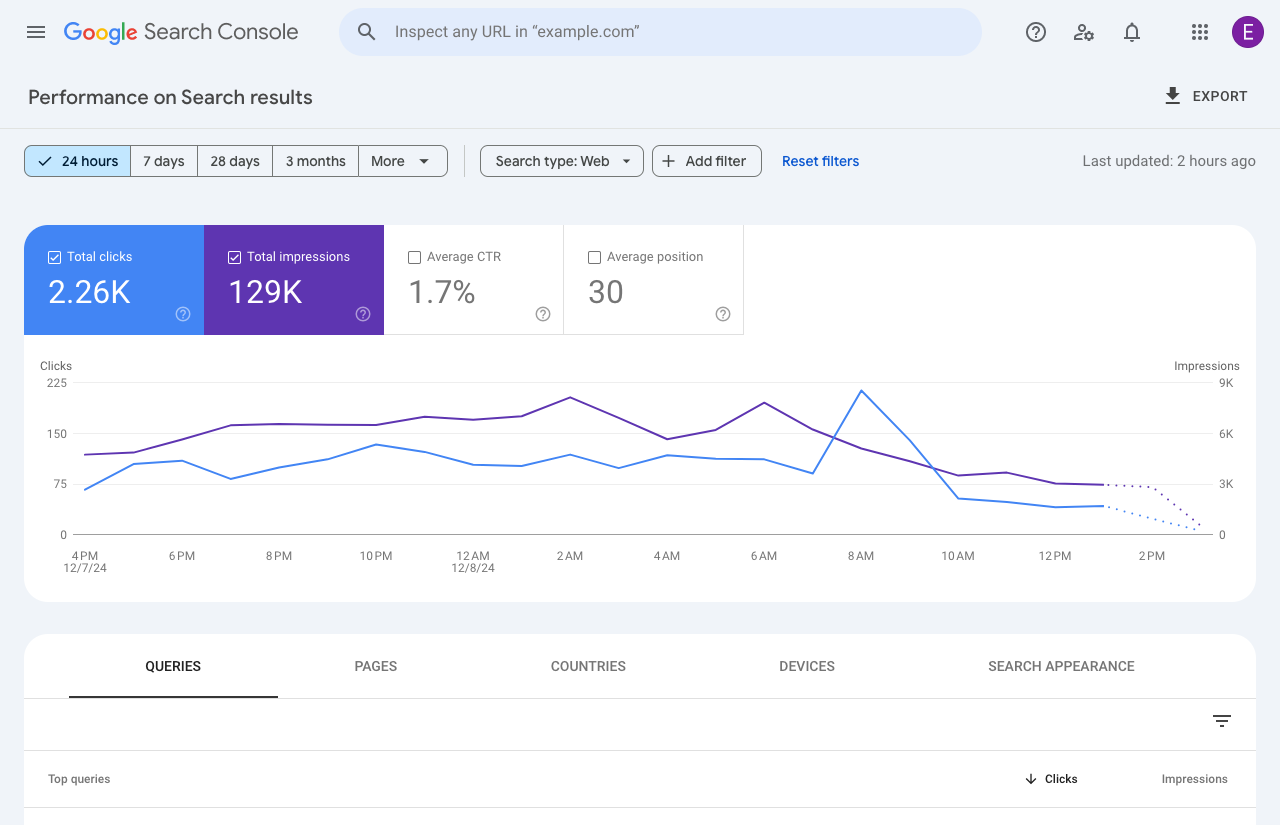
  3. In the date range selector at the top, choose the new “24 hours” option.
An image showing the 24 hours view in Google Search Console.

You’ll see a detailed graph showing hourly trends, and the accompanying tables will reflect the data for that recent period.

Remember, dotted lines on the graph indicate preliminary data that is still being collected, so while incredibly fresh, it might not be final.

What This Means for SEO

The addition of hourly data in GSC is another clear signal from Google: SEO is becoming increasingly dynamic and data-driven.

In a world where AI Overviews are becoming more prominent and real-time user intent shifts rapidly, having immediate feedback on your site’s performance is no longer a luxury – it’s a necessity.

This update empowers us to be more agile, make faster, more informed decisions, and ultimately, stay ahead in the ever-evolving world of search engine optimization.

So, dive into your GSC, explore the new 24-hour view, and unlock a new level of insight for your website’s performance!